
Development & Planning


Arboricultural impact assessments contain an appraisal of the pre-construction situation on the site. This includes an assessment of tree quality under British Standard BS5837:2012, taking into account the trees’ individual arboricultural, landscape, and cultural or ecological values and their estimated remaining contribution.
Learn More
Arboriculture method statements are required to accompany planning applications on sites containing trees plan approval on sites containing trees. This document provides step-by-step instructions associated with tree works and tree protection measures required throughout the construction process.
Learn More
Construction and development cause disruptions that can be harmful to trees, so a Tree Protection Plan (TPP) is vital. A TPP is a plan that highlights the actions taken to protect trees from potential disturbances that may be harmful to them.
Learn More
The Tree Constraints Plan is used before embarking on a development project. The plan considers the constraints caused by trees and their roots. Which divides it into a two-part assessment: above-ground constraints and below-ground constraints.
Learn More
Assessments


Holly Arboriculture performs risk assessments for decaying or extensively damaged trees. The results will tell you the magnitude of the hazard, the probability that the tree will fail, and the value of what is at risk if the tree falls. We will provide the information you need to make an informed decision about treating the decaying tree or removing it.
Learn More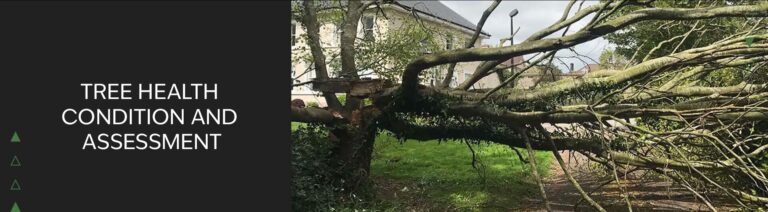
Our team can help you identify any issues that might cause your tree or its branches to come down, helping to increase the safety of the area and reduce the risk of property damage. Tree assessments will allow Holly Arboriculture to effectively evaluate a tree’s condition and provide a diagnosis, as well as a solution to help maintain the good health of your trees.
Learn More
Arborists perform an Aerial Tree Inspection to adequately assess a tree’s condition. A defect on a tree may be positioned in an area not visible from ground level or is too high up to accurately assess its likely implication. This is often the case with tall trees, ivy-covered trees, or trees that have dense crowns.
Learn More
Tree safety management is a matter of limiting the risk of harm from tree failure, while maintaining the benefits provided by trees. Although it may seem counterintuitive, the condition of trees should not be the first consideration. We first consider the usage of the land upon which trees are growing. This will inform how we go about the process of assessing trees.
Learn More
Other Surveys

Trees often host legally protected wildlife including bats and breeding birds. We work with our partner to provide a combination of other services.
Learn MoreTrusted by Leading Industry Professionals


