


Tree Risk Management Strategy: Why It Matters and How It Protects Your Site
At Holly Arboriculture, we recently hosted a webinar titled “Tree Risk Management Strategy – Health & Safety Compliance for Tree Owners.” It was created with golf clubs, estates, hotels, parks, and local authorities in mind—anyone responsible for land where trees and people share space.
We were genuinely encouraged by the response. Attendees told us the session was “eye-opening,” “very relevant,” and “packed with useful information.”
If you missed it, here’s a breakdown of what we covered—and why now might be the right time to take a fresh look at your trees.
What Is a Tree Risk Management Strategy?
Put simply, a Tree Risk Management Strategy (TRMS) is a working document that helps landowners make informed, proportionate decisions about tree safety.
It’s not about cutting down healthy trees “just in case.” It’s about:
-
Balancing safety with the benefits trees bring
-
Setting out how often trees are inspected, and by whom
-
Making sure the right action is taken—at the right time
-
Showing you’ve fulfilled your duty of care
“It’s a practical, live working document—not something that gathers dust on a shelf.”
— Paul Holly, Arboricultural Consultant
Why Golf Courses Are Taking Note and Have Tree Risk Management Strategy
Golf courses, in particular, are seeing the value in a TRMS.
Trees enhance the beauty and character of a course—but also come with risks. One decaying limb near a fairway or walkway could cause serious injury, downtime, or legal consequences.
A clear strategy ensures:
-
Golfer and staff safety
-
Ongoing compliance with Health & Safety laws
-
Smart tree care that doesn’t disrupt play or course aesthetics
-
Budgeting becomes easier because inspections and works are scheduled in advance
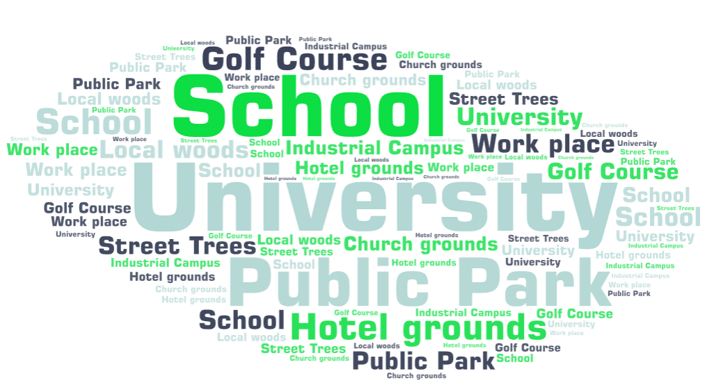
While this example focuses on golf courses, the same principles apply to hotels with landscaped grounds—especially those used for weddings or events—and public parks where children play, and people walk under trees daily. Wherever trees and people mix, a Tree Risk Management Strategy is essential.
What’s in a Good Tree Risk Management Strategy?
We walked attendees through the key elements of an effective TRMS, including:
-
Mission statement (linking tree care to guest experience)
-
Zone mapping (prioritising inspections in high-use areas like entrances, walkways, and car parks)
-
Inspection types and frequency
-
Qualified vs. informal monitoring
-
Closure policies for storm warnings
-
Failure logs and external audits
-
Integration with existing policies, like estate maintenance and biodiversity plans
Everything is grounded in real-world application, not theory.
Keeping It Accountable: Internal and External Audits
A Tree Risk Management Strategy isn’t something you create once and forget about—it’s a live document that needs to evolve with your site.
That’s where internal and external audits come in.
I attended the Tree Risk Management Strategy webinar with Holly Arboriculture and I found the content excellent, particularly how important and valuable is to keep proper records of tree inspections.
Greg O’Connor – Head Greenkeeper – Limerick Golf Club
Internal Audits
These are regular reviews to check:
-
Are inspections happening as planned?
-
Are resources being used effectively?
-
Is the strategy still relevant to how the site is actually used?
It’s an opportunity for landowners or site managers to step back and fine-tune how tree risk is being managed—based on real data, not assumptions.

External Audits
Bringing in an independent arborist for an external review adds another layer of confidence.
It shows insurers, stakeholders, and the public that your strategy isn’t just in place—it’s being properly implemented and checked by professionals.
This level of transparency and accountability helps demonstrate that you’re meeting your duty of care under health and safety legislation. It also reduces the risk of liability if something ever goes wrong.
Not Technical? No Problem
Many of our clients aren’t arborists. That’s exactly why we run these webinars—to simplify things.
The content of the Tree Risk Management Strategy was very good and I found it very relevant to the Bandon Golf Club’s needs at present.
James Curran – Administration Manager – Bandon Golf Club
Here are some common search terms your peers are using when they first reach out:
-
tree safety
-
how to check if a tree is dangerous
-
tree inspections for golf courses
-
do I need a tree survey for insurance?
-
tree near footpath—is it safe?
-
tree falling risk on my land
If any of those sound familiar, we can help.
Want to Learn More?
We also help landowners and managers put structured Tree Risk Management Strategy (TRMS) in place. These strategies are tailored to each site and help ensure trees are inspected appropriately, risks are identified early, and clear records are kept. Whether you manage a golf course, hotel grounds, or a public park, a TRMS demonstrates that you are meeting your legal duty of care while protecting the value and safety of your landscape. It’s a practical way to stay ahead of issues, plan maintenance sensibly, and reduce liability.
If you’d like to discuss your site , get in touch here.
You can also visit our Case Studies page to see how this approach has been applied across golf courses, hotels, estates, parks, and public spaces.